Review Article | | Peer-Reviewed

Farmers’ Awareness and Perceptions of Seasonal Soil Dynamics Across Agricultural Land-Use Systems

Received: 29 January 2026     Accepted: 26 February 2026     Published: 12 March 2026
Views:       Downloads:
Abstract

Seasonal soil dynamics, expressed through changes in moisture, temperature, structure, porosity, colour and nutrient availability, are central to agricultural productivity and sustainability. These changes are shaped by land-use systems and management practices, yet farmers’ understanding and interpretation remain underexplored across agricultural systems. This study comparatively examines farmers’ awareness and perceptions of seasonal soil changes across varied land-use systems in southwestern Nigeria. A cross-sectional survey of 700 farmers was conducted using structured questionnaires to capture awareness, perceptions, and information sources related to seasonal soil dynamics. Data were analysed using descriptive statistics and chi-square tests. Results show generally high awareness of seasonal soil variability, with 69.7% of respondents very aware of wet–dry season differences and 58.1% rating their awareness as very high. The dry season was identified as the least productive period by 97.0% of farmers, while 80.9% linked low yields to declining soil conditions. Most farmers relied on personal experience rather than formal extension services. Wet-season improvements in soil properties contrasted sharply with widespread dry-season degradation. The chi-square test indicated a statistically significant deviation in awareness levels (χ² = 467.93, p < 0.05), highlighting the need to integrate farmers’ experiential knowledge with scientific soil assessment and targeted extension support programmes.

Published in American Journal of Agriculture and Forestry (Volume 14, Issue 2)
DOI 10.11648/j.ajaf.20261402.12
Page(s) 92-97
Creative Commons

This is an Open Access article, distributed under the terms of the Creative Commons Attribution 4.0 International License (http://creativecommons.org/licenses/by/4.0/), which permits unrestricted use, distribution and reproduction in any medium or format, provided the original work is properly cited.

Copyright

Copyright © The Author(s), 2026. Published by Science Publishing Group

Keywords

Seasonal Soil Dynamics, Farmer Awareness, Agricultural Land-Use Systems, Soil Productivity, Sustainable Soil Management

1. Introduction
Soil constitutes the foundation of agricultural production, yet it is not a static medium. Rather, soil is a dynamic and living system whose physical, chemical, and biological properties vary seasonally in response to climatic conditions and land management practices. Seasonal soil dynamics, including fluctuations in moisture, temperature, structure, nutrient availability, and biological activity, exert direct and indirect effects on crop growth, yield stability, and long-term soil sustainability . In tropical agro-ecosystems, where rainfall regimes are strongly seasonal, these variations are particularly pronounced and consequential.
Agricultural land-use systems, such as annual cropping, agroforestry, and conservation-based systems, differ substantially in how they mediate seasonal soil processes. Management practices, including tillage intensity, residue management, fertilizer application, and crop diversification, influence the extent to which soils retain moisture, resist erosion, and sustain nutrient cycling across seasons . Seasonal changes in soil temperature and moisture further interact with land-use practices to shape nutrient availability, especially nitrogen dynamics, highlighting the sensitivity of soil fertility to both climatic and management factors .
Despite extensive scientific understanding of soil processes, the effectiveness of sustainable soil management ultimately depends on farmers’ awareness, perceptions, and interpretations of soil change. Farmers’ decisions are strongly shaped by experiential knowledge, local beliefs, and socio-economic constraints, which influence how environmental signals are perceived and acted upon . Indigenous and local knowledge systems have historically supported farmers’ capacity to manage seasonal variability; however, these systems are increasingly challenged by climate change, agricultural intensification, and shifting socio-economic conditions .
Research shows that farmers’ awareness of soil dynamics varies widely. Many farmers easily identify visible signs such as soil hardness or surface crusting, but are less aware of slower, hidden processes like organic matter decline or changes in microbial activity . Research from the African Highlands highlights that this focus on surface indicators hinders the adoption of sustainable land management practices, especially when extension services are limited . Additionally, farmers' perceptions are influenced by their access to information, cultural beliefs, economic constraints, and attitudes towards risk, resulting in varied responses even in similar environmental conditions .
While seasonal soil dynamics have been widely documented in soil science literature , integrated analyses that link land-use systems, farmer awareness, and perceptions of seasonal soil change remain limited. This knowledge gap restricts effective communication between scientific research and farm-level decision-making. Having insight into how farmers perceive and interpret seasonal soil dynamics across different land-use systems is therefore essential for designing context-appropriate soil management strategies.
This study addresses this gap by comparatively analysing farmers’ awareness and perceptions of seasonal soil dynamics across varied agricultural land-use systems in some parts of Ondo State, southwestern Nigeria. Specifically, the study aims to (i) assess farmers’ awareness of seasonal soil changes, (ii) examine their perceptions of how these changes affect soil productivity and crop performance, and (iii) evaluate the implications for sustainable soil management and climate adaptation. By grounding analysis in farmers’ lived experiences, the study seeks to inform the co-design of extension strategies and policies that enhance soil resilience and agricultural sustainability.
2. Materials and Methods
2.1. Study Area
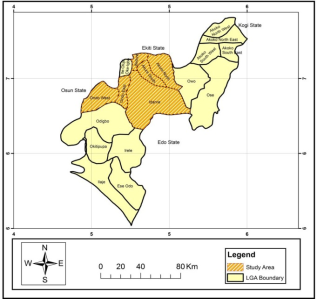
The study was conducted in six Local Government Areas (LGA) of Ondo State, southwestern Nigeria. Ondo State lies within the tropical rainforest zone and experiences a humid climate characterized by distinct wet and dry seasons. The region is underlain by diverse soil types, predominantly Alfisols, which support crops such as cocoa, cassava, and maize. Geological formations include Precambrian Basement Complex rocks in the northern parts and sedimentary formations in the south, contributing to spatial variability in soil properties and agricultural potential. Agriculture constitutes the dominant livelihood activity, complemented by forestry and trading.
Source: Modified After Ondo State Survey Department, Akure

Download: Download full-size image

Figure 1. Map of Ondo State showing the study Areas.
2.2. Research Design and Sampling
A cross-sectional survey design was adopted to capture farmers’ awareness and perceptions at a single point in time. A stratified random sampling approach ensured representation across different agricultural land-use systems and socio-demographic categories. A total of 700 farmers participated in the study. The sample size was determined using Yamane’s (1967) formula and supported by convenience sampling to ensure adequate statistical power.
2.3. Data Collection
Primary data were collected through face-to-face administration of structured questionnaires. The instrument captured information on socio-demographic characteristics, observations of seasonal soil changes, perceived impacts on crop productivity, awareness of soil indicators, and sources of information regarding soil dynamics.
2.4. Variables and Data Analysis
Farmers’ awareness levels were measured on a five-point Likert scale ranging from “not aware” to “very aware.” Perceptions of seasonal soil change were recorded using categorical responses. Data were analysed using descriptive statistics and chi-square tests to examine deviations in awareness levels. Statistical significance was assessed at p < 0.05 using SPSS version 23.
3. Results
3.1. Awareness of Seasonal Soil Changes
Farmers demonstrated a high level of awareness of seasonal soil changes (Table 1). A majority (69.7%) reported being very aware of differences in soil quality between the wet and dry seasons, while 23.0% indicated moderate awareness. Only a small fraction (7.2%) reported low awareness, and 2.1% were unsure.
Table 1. Farmer awareness of seasonal soil changes.

Awareness level

Frequency

Percentage (%)

Very aware

488

69.7

Moderately aware

161

23.0

Not very aware

36

5.1

Not sure

15

2.1

Total

700

100.0

Author’s Analysis, 2025
When asked to rate their overall awareness of soil changes across seasons (Table 2), 58.1% reported very high awareness, 20.0% reported high awareness, 19.3% moderate awareness, and 2.6% low awareness.
Table 2. Self-rated awareness of soil changes across seasons.

Self-rated awareness level

Frequency

Percentage (%)

Very high

407

58.1

High

140

20.0

Moderate

135

19.3

Low

18

2.6

Total

700

100.0

Author’s Analysis, 2025
3.2. Seasonal Productivity Perceptions
Farmers were asked which season they considered least productive (Table 3). An overwhelming majority (97.0%) identified the dry season as the period of lowest soil productivity.
Table 3. Seasonal soil productivity perceptions.

Least productive season

Frequency

Percentage (%)

Dry season

679

97.0

Planting season

11

1.6

Harvesting season

10

1.4

Total

700

100.0

Author’s Analysis, 2025
When asked whether low crop yields were associated with poor seasonal soil conditions, 80.9% agreed, while 19.1% did not make this connection.
3.3. Sources of Information
Farmers largely relied on personal experience as their primary source of information about how soil changes (Table 4). Experiences accounted for 69.0% of responses, while extension programmes (9.7%), community meetings or seminars (10.4%), school (1.9%), and media (1.1%) were less commonly cited.
Table 4. Sources of information about soil changes.

Source of information

Frequency

Percentage (%)

Personal experience

483

69.0

Community meetings/seminars

73

10.4

Extension programme

68

9.7

School

13

1.9

Media

8

1.1

Combination (others)

55

7.9

Total

700

100.0

Author’s Analysis, 2025
3.4. Seasonal Soil Property Observations
During the wet season, 81.6% of farmers observed increased soil moisture, whereas a smaller proportion (18.4%) noted erosion as a prominent characteristic. Observations of improved soil physical properties, including texture, structure, porosity, and nutrient availability, reflected a positive view of wet season conditions.
3.5. Seasonal Changes in Soil Physical Properties
Farmers reported pronounced seasonal differences in soil physical properties across land-use systems. During the wet season, most respondents perceived improvements in soil condition (Table 5). Improved soil texture was reported by 97.7% of farmers, while soil structure (91.4%), nutrient status (96.0%), porosity (93.3%), and color (83.6%) were also widely perceived to improve. These responses suggest that rainfall plays a critical role in enhancing soil physical quality and productivity.
Table 5. Perceived soil changes during the wet season (n = 700).

Soil property

Improved (%)

Constant (%)

Declined (%)

Texture

97.7

1.7

0.6

Structure

91.4

7.9

0.7

Nutrients

96.0

3.9

0.1

Porosity

93.3

5.9

0.9

Colour

83.6

14.7

1.7

Author’s Analysis, 2025
In contrast, the dry season was associated with widespread soil degradation (Table 6). A majority of farmers reported declines in soil texture (85.9%), structure (91.0%), nutrients (85.0%), porosity (95.9%), and color (74.1%), reflecting the negative impacts of moisture stress.
Table 6. Perceived soil changes during the dry season (n = 700).

Property

Improved (%)

Constant (%)

Declined (%)

Texture

0.4

13.7

85.9

Structure

0.3

8.7

91.0

Nutrients

0.1

14.9

85.0

Porosity

1.3

2.9

95.9

Colour

0.1

25.7

74.1

Author’s Analysis, 2025
Farmers also showed strong awareness of climate-related soil challenges, with most attributing soil degradation to inadequate rainfall, shortened wet seasons, prolonged dry seasons, and increased temperatures. Rising temperature was strongly linked to soil compaction and nutrient decline. In addition, 75.3% of farmers associated cattle invasion during dry periods with soil degradation.
Regarding soil fertility management, most farmers relied on visual observation (83.7%) to assess soil fertility, and soil compaction was identified as the major dry-season challenge (64.6%). Most respondents (79.4%) recognized soil differences across land-use types, while fertility management was dominated by inorganic fertilizer use (58.7%), with limited application of organic amendments.
3.6. Statistical Difference in Farmers’ Awareness and Perception of Seasonal Soil Dynamics
A chi-square test results in Table 7, revealed a statistically significant deviation from the expected distribution, χ² (3, N = 700) = 467.93, p< 0.05. Specifically, the majority of farmers (n = 407) reported a "Very High" level of awareness, which is considerably higher than the expected count of 175. Conversely, only 18 farmers reported "Low" awareness, which is substantially below the expected frequency. The categories "High" and "Moderate" also showed smaller but notable deviations from expectation, with 140 and 135 responses, respectively.
Table 7. Contingency Table: Rating of Awareness of Soil Changes.

Awareness Level

Observed (O)

Expected (E = 700/4)

(O - E)^2 / E

Very High

407

175

303.88

High

140

175

7.00

Moderate

135

175

9.14

Low

18

175

147.91

Total

700

467.93

Author’s Analysis, 2025
4. Discussions
The findings demonstrate a high level of farmer awareness of seasonal soil dynamics, particularly the contrast between wet and dry seasons. The predominance of “very high” awareness reflects the strength of experiential knowledge accumulated through long-term engagement with local agro-ecosystems. Similar studies emphasize that repeated exposure to climatic variability sharpens farmers’ ability to interpret environmental change .
The widespread identification of the dry season as the least productive period aligns with established evidence linking moisture deficits to soil compaction, reduced porosity, and nutrient decline . Farmers’ attribution of yield losses to poor seasonal soil conditions further underscores the salience of soil moisture as a key driver of productivity in rain-fed systems.
However, the heavy reliance on personal experience as the primary information source highlights a critical gap in formal knowledge dissemination. While experiential knowledge enables farmers to respond to visible soil changes, it may limit awareness of less observable processes such as organic matter depletion or microbial dynamics . This pattern echoes findings from Okoro & Tordue, who emphasize the need to integrate scientific soil assessment with farmers’ local observations .
Perceived wet-season improvements in soil texture, structure, and nutrient status are consistent with evidence that adequate moisture enhances aggregation and nutrient cycling . Conversely, widespread reports of dry-season degradation reflect processes such as crusting and compaction under moisture stress . Farmers’ limited recognition of erosion during the wet season suggests potential underestimation of long-term soil loss risks, supporting earlier observations by Yusuf .
The significant variation in awareness levels indicates that land-use systems and management practices influence how farmers perceive seasonal soil change. Diversified systems may buffer climatic extremes, while monoculture systems expose farmers to more pronounced degradation signals. These findings reinforce the importance of tailoring extension interventions to specific land-use contexts.
5. Implications for Sustainable Soil Management
The results highlight the need for soil management strategies that build upon farmers’ existing knowledge while addressing identified gaps. Extension programmes should link scientific soil indicators with observable field-level signs to enhance relevance and adoption. Climate-smart practices, such as residue retention, cover cropping, and organic amendments, can be more effectively promoted when framed in terms of farmers’ experiences with moisture retention and soil degradation.
6. Conclusion
This study demonstrates that farmers across different agricultural systems possess a high level of awareness of seasonal soil dynamics and their implications for crop productivity. While experiential knowledge forms a strong foundation for soil management decisions, limited engagement with scientific insights constrains the adoption of sustainable practices. Bridging local knowledge with science-based soil management through targeted extension support is essential for enhancing soil resilience, climate adaptation, and long-term agricultural sustainability.
Abbreviations

LGA

Local Government Area

Author Contributions
Olukemi Abimbola Funmilayo: Conceptualization, Project administration, Supervision, Validation
Temidayo Michael Fapohunda: Funding Acquisition, Writing – review & editing
Albert Orodena Aweto: Conceptualization, Project administration, Supervision, Validation, Visualization
Conflicts of Interest
The authors hereby acknowledge the financial support of the Tertiary Education Trust Fund (TETFund), Nigeria. And by this, the authors declare no conflicts of interest.
References
[1] Adeyolanu, O. D., Are, K. S., Adelana, A. O., Oluwatosin, G. A., Denton, O. A., Ande, O. T., & Adediran, J. A. 2018. Assessing soil quality issues for crop production function based on farmers’ perception: an experience from Itapaji watershed in southwestern Nigeria. Eurasian Journal of Soil Science (EJSS), 7.4: 337-345.
[2] Akinbode, S. O., Folorunso, O., Olutoberu, T. S., Olowokere, F. A., Adebayo, M., Azeez, S. O., Hammed, S. G., & Busari, M. A. (2024). Farmers’ perception and practice of soil fertility management and conservation in the era of digital soil information systems in southwest Nigeria. Agriculture, 14(7), 1182.
[3] Ali, A. Y. (2025). Perception of farmers on soil erosion and sustainable land management practices in Semen Bench District, Southwest Ethiopia. International Journal of Ecotoxicology and Ecobiology, 10(4), 104-113.
[4] Bünemann, E. K., Bongiorno, G., Bai, Z., Creamer, R. E., De Deyn, G., de Goede, R., Fleskens, L., Geissen, V., Kuyper, T. W., Mäder, P., Pulleman, M., Sukkel, W., van Groenigen, J. W., & Brussaard, L. (2018). Soil quality - A critical review. Soil Biology and Biochemistry, 120, 105-125.
[5] Dessart, F. J., Barreiro-Hurlé, J., & van Bavel, R. (2019). Behavioural factors affecting the adoption of sustainable farming practices: A policy-oriented review. European Review of Agricultural Economics, 46(3), 417-471.
[6] Eze, S., Dougill, A. J., Banwart, S. A., Sallu, S. M., Smith, H. E., Tripathi, H., Mgohele, R. N., & Senkoro, C. J. (2021). Farmers’ indicators of soil health in the African Highlands and implications for sustainable land management. Journal of Soil and Water Conservation. CATENA, 203(3)
[7] Lemla, W., Singh, M. R., & Temjen, W. (2025). Seasonal variations and land-use impacts on soil fertility in the riparian zone of the Dhansiri River, North East India. Indian Journal of Ecology, 52(3), 580-585.
[8] Okoro, D. & Tordue, I. P. (2023). Effects of seasonal variation on some soil chemical properties under different land use in Santa Barbara, Bayelsa State, Nigeria. Chemical Science International Journal, 32(4), 39-49.
[9] Oladele, O. I., & Amara, A. (2024). Farmers’ use of Indigenous knowledge on climate change adaptation across farming systems and agroecological zones of Sierra Leone. AlterNative: An International Journal of Indigenous Peoples, 20(3), 473-483.
[10] Onemayin, J., Olayiwola, V., Abiodun, F., Musa, F., & Idris, R. (2020). Land use influence on some soil physical and chemical properties of an Alfisol at forestry research institute of Nigeria. International Journal of Plant & Soil Science, 1-8.
[11] Pittelkow, C. M., Liang, X., Linquist, B. A., van Groenigen, K. J., Lee, J., Lundy, M. E., van Gestel, N., Six, J., Venterea, R. T., & van Kessel, C. (2015). Productivity limits and potentials of the principles of conservation agriculture. Nature, 517(7534), 365-368.
[12] Powlson, D. S., Stirling, C. M., Jat, M. L., Gerard, B. G., Palm, C. A., Sanchez, P. A., & Cassman, K. G. (2016). Does conservation agriculture deliver climate change mitigation through soil carbon sequestration in tropical agro-ecosystems? Agriculture, Ecosystems & Environment, 220, 164-174.
[13] Prokopy, L. S., Floress, K., Arbuckle, J. G., Church, S. P., Eanes, F. R., Gao, Y., Gramig, B. M., Ranjan, P., & Singh, A. S. (2019). Adoption of agricultural conservation practices in the United States: Evidence from 35 years of quantitative literature. Journal of Soil and Water Conservation, 74(5), 520-534.
[14] Sharna, S. C., Maraseni, T., Pede, V. O., & Radanielson, A. (2025). How farmers’ perceptions about sustainable soil management practices affect their behaviour towards future adoption in climate-hazardous locations. Soil and Tillage Research, 249.
[15] Tarfa, P. Y., Ayuba, H. K., Onyeneke, R. U., Nwajiuba, C. A., & Igberi, C. O. (2019). Climate change perception in Nigeria’s Guinea savanna: evidence from farmers in Nasarawa State, Nigeria. Applied Ecology and Environmental Research, 17(3). 7085-7112.
[16] Yeleliere, E., Antwi-Agyei, P., & Guodaar, L. (2023). Farmers' response to climate variability and change in rainfed farming systems: insight from lived experiences of farmers. Heliyon, 9(9). e19656.
[17] Yusuf, M., Mustafa, F., & Salleh, K. (2017). Farmer perception of soil erosion and investment in soil conservation measures: emerging evidence from northern Taraba state, Nigeria. Soil Use and Management, 33(1). 163-173.
Cite This Article
  • APA Style

    Funmilayo, O. A., Fapohunda, T. M., Aweto, A. O. (2026). Farmers’ Awareness and Perceptions of Seasonal Soil Dynamics Across Agricultural Land-Use Systems. American Journal of Agriculture and Forestry, 14(2), 92-97. https://doi.org/10.11648/j.ajaf.20261402.12

    Copy | Download

    ACS Style

    Funmilayo, O. A.; Fapohunda, T. M.; Aweto, A. O. Farmers’ Awareness and Perceptions of Seasonal Soil Dynamics Across Agricultural Land-Use Systems. Am. J. Agric. For. 2026, 14(2), 92-97. doi: 10.11648/j.ajaf.20261402.12

    Copy | Download

    AMA Style

    Funmilayo OA, Fapohunda TM, Aweto AO. Farmers’ Awareness and Perceptions of Seasonal Soil Dynamics Across Agricultural Land-Use Systems. Am J Agric For. 2026;14(2):92-97. doi: 10.11648/j.ajaf.20261402.12

    Copy | Download

  • @article{10.11648/j.ajaf.20261402.12,
      author = {Olukemi Abimbola Funmilayo and Temidayo Michael Fapohunda and Albert Orodena Aweto},
      title = {Farmers’ Awareness and Perceptions of Seasonal Soil Dynamics Across Agricultural Land-Use Systems},
      journal = {American Journal of Agriculture and Forestry},
      volume = {14},
      number = {2},
      pages = {92-97},
      doi = {10.11648/j.ajaf.20261402.12},
      url = {https://doi.org/10.11648/j.ajaf.20261402.12},
      eprint = {https://article.sciencepublishinggroup.com/pdf/10.11648.j.ajaf.20261402.12},
      abstract = {Seasonal soil dynamics, expressed through changes in moisture, temperature, structure, porosity, colour and nutrient availability, are central to agricultural productivity and sustainability. These changes are shaped by land-use systems and management practices, yet farmers’ understanding and interpretation remain underexplored across agricultural systems. This study comparatively examines farmers’ awareness and perceptions of seasonal soil changes across varied land-use systems in southwestern Nigeria. A cross-sectional survey of 700 farmers was conducted using structured questionnaires to capture awareness, perceptions, and information sources related to seasonal soil dynamics. Data were analysed using descriptive statistics and chi-square tests. Results show generally high awareness of seasonal soil variability, with 69.7% of respondents very aware of wet–dry season differences and 58.1% rating their awareness as very high. The dry season was identified as the least productive period by 97.0% of farmers, while 80.9% linked low yields to declining soil conditions. Most farmers relied on personal experience rather than formal extension services. Wet-season improvements in soil properties contrasted sharply with widespread dry-season degradation. The chi-square test indicated a statistically significant deviation in awareness levels (χ² = 467.93, p < 0.05), highlighting the need to integrate farmers’ experiential knowledge with scientific soil assessment and targeted extension support programmes.},
     year = {2026}
    }
    

    Copy | Download

  • TY  - JOUR
    T1  - Farmers’ Awareness and Perceptions of Seasonal Soil Dynamics Across Agricultural Land-Use Systems
    AU  - Olukemi Abimbola Funmilayo
    AU  - Temidayo Michael Fapohunda
    AU  - Albert Orodena Aweto
    Y1  - 2026/03/12
    PY  - 2026
    N1  - https://doi.org/10.11648/j.ajaf.20261402.12
    DO  - 10.11648/j.ajaf.20261402.12
    T2  - American Journal of Agriculture and Forestry
    JF  - American Journal of Agriculture and Forestry
    JO  - American Journal of Agriculture and Forestry
    SP  - 92
    EP  - 97
    PB  - Science Publishing Group
    SN  - 2330-8591
    UR  - https://doi.org/10.11648/j.ajaf.20261402.12
    AB  - Seasonal soil dynamics, expressed through changes in moisture, temperature, structure, porosity, colour and nutrient availability, are central to agricultural productivity and sustainability. These changes are shaped by land-use systems and management practices, yet farmers’ understanding and interpretation remain underexplored across agricultural systems. This study comparatively examines farmers’ awareness and perceptions of seasonal soil changes across varied land-use systems in southwestern Nigeria. A cross-sectional survey of 700 farmers was conducted using structured questionnaires to capture awareness, perceptions, and information sources related to seasonal soil dynamics. Data were analysed using descriptive statistics and chi-square tests. Results show generally high awareness of seasonal soil variability, with 69.7% of respondents very aware of wet–dry season differences and 58.1% rating their awareness as very high. The dry season was identified as the least productive period by 97.0% of farmers, while 80.9% linked low yields to declining soil conditions. Most farmers relied on personal experience rather than formal extension services. Wet-season improvements in soil properties contrasted sharply with widespread dry-season degradation. The chi-square test indicated a statistically significant deviation in awareness levels (χ² = 467.93, p < 0.05), highlighting the need to integrate farmers’ experiential knowledge with scientific soil assessment and targeted extension support programmes.
    VL  - 14
    IS  - 2
    ER  - 

    Copy | Download

Author Information
  • Abstract
  • Keywords
  • Document Sections

    1. 1. Introduction
    2. 2. Materials and Methods
    3. 3. Results
    4. 4. Discussions
    5. 5. Implications for Sustainable Soil Management
    6. 6. Conclusion
    Show Full Outline
  • Abbreviations
  • Author Contributions
  • Conflicts of Interest
  • References
  • Cite This Article
  • Author Information