
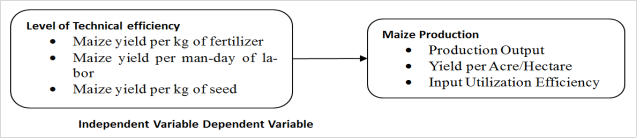
Maize remains a cornerstone crop for food security and livelihoods in Kenya, particularly in the high-producing counties of Uasin Gishu and Transzoia. Although these regions have the potential to yield 900,000 and 1,000,000 metric tons respectively, actual production lags considerably at approximately 400,000 and 600,000 metric tons. This productivity gap underscores inefficiencies in how resources are utilized by smallholder farmers. This study evaluated resource use efficiency and explored key determinants impacting maize production among a sample of 274 farmers drawn from a population of 16,300 using stratified random sampling guided by Cochran’s formula. Primary data were collected through a structured, self-administered questionnaire designed on a 5-point Likert scale, and the analysis was grounded in production theory and efficiency analysis using a stochastic frontier model estimated by maximum likelihood. Utilizing descriptive statistics alongside Stochastic Frontier Analysis, the findings revealed an average technical efficiency of 82%, with scores ranging between 75% and 91%. Major contributors to inefficiency included limited education, smaller farm sizes, and inadequate access to extension services. The input-output analysis further showed that seed was the most efficiently utilized resource, with an input-output ratio of 66.67, whereas fertilizer and labor recorded lower ratios of 13.33 and 6.67, respectively. Farmers with more than two acres of land, college-level education or above, and access to credit reported higher resource efficiency ratings. The research highlights that optimizing resource use could increase maize yields by up to 25%, advocating for policies that improve farmer training, expand extension outreach, and enhance access to modern inputs to drive sustainable productivity gains.
| Published in | American Journal of Agriculture and Forestry (Volume 14, Issue 5) |
| DOI | 10.11648/j.ajaf.20261405.12 |
| Page(s) | 241-247 |
| Creative Commons |
This is an Open Access article, distributed under the terms of the Creative Commons Attribution 4.0 International License (http://creativecommons.org/licenses/by/4.0/), which permits unrestricted use, distribution and reproduction in any medium or format, provided the original work is properly cited. |
| Copyright |
Copyright © The Author(s), 2026. Published by Science Publishing Group |
Resource Use Efficiency, Maize Farming, Smallholder Agriculture, Technical Efficiency, Stochastic Frontier Analysis, Kenya
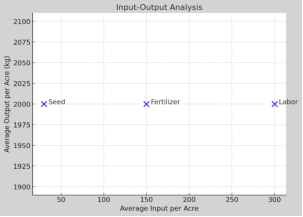
Input | Average Input per Acre | Average Output per Acre (kg) | Input-Output Ratio |
|---|---|---|---|
Fertilizer | 150 kg | 2,000 | 13.33 |
Labor | 300 man-days | 2,000 | 6.67 |
Seed | 30 kg | 2,000 | 66.67 |
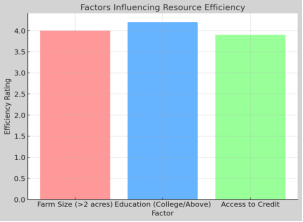
Factor | Efficiency Rating | Frequency | Percentage |
|---|---|---|---|
Farm Size (>2 acres) | 4.0 | 120 | 43.7% |
Education (College/Above) | 4.2 | 150 | 54.8% |
Access to Credit | 3.9 | 100 | 36.4% |
SFA | Stochastic Frontier Analysis |
TE | Technical Efficiency |
AE | Allocative Efficiency |
EE | Economic Efficiency |
FAO | Food and Agriculture Organization |
MALF | Ministry of Agriculture, Livestock, and Fisheries |
KALRO-KCEP | Kenya Agricultural and Livestock Research Organization - Kenya Climate-smart Agriculture Project |
CIMMYT | International Maize and Wheat Improvement Center |
DEA | Data Envelopment Analysis |
ORCID | Open Researcher and Contributor ID |
GDP | Gross Domestic Product |
| [1] | Anderson, J., & Feder, G. (2020). Agricultural extension: Good intentions and hard realities. World Bank Research Observer, 15(1), 41–60. |
| [2] | CIMMYT. (2019). Kenya maize sector situation analysis. International Maize and Wheat Improvement Center. |
| [3] | Coelli, T., & Battese, G. E. (2006). An introduction to efficiency and productivity analysis (2nd ed.). Springer. |
| [4] |
Dlamini, B., Senzanje, A., & Chikodzi, D. (2010). Factors influencing technical efficiency of maize production: A case study of smallholder farmers in Swaziland. African Journal of Agricultural Research, 5(3), 208–215.
https://academicjournals.org/journal/AJAR/article-full-text-pdf/6B3F85E13834 |
| [5] | Esham, M. (2014). Measuring the technical efficiency of smallholder maize farmers in Sri Lanka: A stochastic frontier analysis. Journal of Development and Agricultural Economics, 6(5), 224–232. |
| [6] | FAO. (2019). The state of food and agriculture 2019: Moving forward on food loss and waste reduction. Food and Agriculture Organization of the United Nations. |
| [7] | FAO. (2020). Kenya country profile. Food and Agriculture Organization of the United Nations. |
| [8] | FAO. (2022). FAOSTAT statistical database. Food and Agriculture Organization of the United Nations. |
| [9] | Fan, S., Pender, J., & MacDonald, J. (2012). Production and efficiency in U.S. maize farming: Econometric analysis of input optimization. Agricultural Economics, 43(3), 251–261. |
| [10] | Geta, E., Alemu, D., & Tsedeke, A. (2013). Resource use efficiency and determinants among smallholder maize farmers in Southern Ethiopia: A stochastic frontier approach. Journal of Development and Agricultural Economics, 5(9), 365–374. |
| [11] | Jacobs, P. (2014). The role of extension services in improving smallholder productivity. Agricultural Extension Worldwide Journal, 10(2), 112–124. |
| [12] | Kenya Agricultural and Livestock Research Organization (KALRO-KCEP). (2016). Maize production performance report. Nairobi, Kenya. |
| [13] | Kenya Markets Trust. (2020). Agricultural market dynamics and efficiency in Kenya. |
| [14] | Kenya Revenue Authority. (2023). Agricultural input subsidy impact report. Nairobi, Kenya. |
| [15] | Ministry of Agriculture, Livestock and Fisheries (MALF). (2020). Uasin Gishu county agricultural production report. Nairobi, Kenya. |
| [16] | Ministry of Agriculture, Livestock and Fisheries (MALF). (2021). Agricultural challenges and climate impact report. Nairobi, Kenya. |
| [17] | Ministry of Agriculture, Livestock and Fisheries (MALF). (2023). Transzoia county maize production statistics. Nairobi, Kenya. |
| [18] | Mather, D., Zeller, M., & Johnson, N. (2022). Optimizing input use for productivity gains in resource-poor environments. Agricultural Systems, 199, 103331. |
| [19] | Ministry of Agriculture. (2021). Kenya agricultural sector development support program. Nairobi, Kenya. |
| [20] | Ministry of Agriculture. (2023). Annual crop production report. Nairobi, Kenya |
| [21] | Ngeno, V., Wandera, S. M., & Muriuki, A. G. (2011). Technical efficiency of maize production in Uasin Gishu County, Kenya: A stochastic frontier approach. African Crop Science Journal, 19(2), 121–130. |
| [22] | Nyagaka, D. O. (2010). Efficiency of resource use in maize production among smallholder farmers in Kenya: An application of production theory. Kenya Agricultural Research Institute Report. |
| [23] | Osei-Afoakwa, L., Danso-Abbeam, G., & Oduro, I. (2019). Improving fertilizer and labor use efficiency for increased maize yields: Evidence from Ghana. African Journal of Agricultural Research, 14(10), 480–489. |
| [24] | Pandey, P., & Pandey, M. (2021). Research methodology: Tools and techniques (4th ed.). Bridge Center. |
| [25] | Parahoo, K. (2005). Nursing research: Principles, process and issues (2nd ed.). Palgrave Macmillan. |
| [26] | Rahi, S. (2017). Research design and methods: A systematic review of research paradigms, sampling issues and instrument development. International Journal of Economics & Management Sciences, 6(2), 1–5. |
| [27] | Salat, S., & Swallow, B. (2018). Enhancing soil organic carbon for improved maize productivity: A case study of Nyando, Kenya. Soil Science Journal, 12(3), 145–154. |
| [28] | Sachs, J., McArthur, J., Schmidt-Traub, G., & Kruk, M. (2004). Ending Africa’s poverty trap. Brookings Papers on Economic Activity, 2004(1), 117–240. |
| [29] | Seaman, J., Frost, C., & Brown, M. (2022). Descriptive research designs in agricultural studies. Agricultural Research Methods, 8(1), 21–29. |
| [30] | Shafiq, M., & Rehman, H. (2000). Technical inefficiency and its determinants in Pakistan’s agriculture: A stochastic frontier approach. Pakistan Journal of Agricultural Sciences, 37(3–4), 120–127. |
| [31] | Swanson, B. E. (2022). Agricultural production theory and efficiency analysis (3rd ed.). Routledge. |
| [32] | World Bank. (2021). Kenya agriculture overview. The World Bank. |
APA Style
Kimais, N. K. (2026). Assessment of Resource Use Efficiency and Its Determinants in Maize Production Among Smallholder Farmers in Uasin Gishu and Transzoia Counties, Kenya. American Journal of Agriculture and Forestry, 14(5), 241-247. https://doi.org/10.11648/j.ajaf.20261405.12
ACS Style
Kimais, N. K. Assessment of Resource Use Efficiency and Its Determinants in Maize Production Among Smallholder Farmers in Uasin Gishu and Transzoia Counties, Kenya. Am. J. Agric. For. 2026, 14(5), 241-247. doi: 10.11648/j.ajaf.20261405.12
@article{10.11648/j.ajaf.20261405.12,
  author = {Nickson Kiprotich Kimais},
  title = {Assessment of Resource Use Efficiency and Its Determinants in Maize Production Among Smallholder Farmers in Uasin Gishu and Transzoia Counties, Kenya},
  journal = {American Journal of Agriculture and Forestry},
  volume = {14},
  number = {5},
  pages = {241-247},
  doi = {10.11648/j.ajaf.20261405.12},
  url = {https://doi.org/10.11648/j.ajaf.20261405.12},
  eprint = {https://article.sciencepublishinggroup.com/pdf/10.11648.j.ajaf.20261405.12},
  abstract = {Maize remains a cornerstone crop for food security and livelihoods in Kenya, particularly in the high-producing counties of Uasin Gishu and Transzoia. Although these regions have the potential to yield 900,000 and 1,000,000 metric tons respectively, actual production lags considerably at approximately 400,000 and 600,000 metric tons. This productivity gap underscores inefficiencies in how resources are utilized by smallholder farmers. This study evaluated resource use efficiency and explored key determinants impacting maize production among a sample of 274 farmers drawn from a population of 16,300 using stratified random sampling guided by Cochran’s formula. Primary data were collected through a structured, self-administered questionnaire designed on a 5-point Likert scale, and the analysis was grounded in production theory and efficiency analysis using a stochastic frontier model estimated by maximum likelihood. Utilizing descriptive statistics alongside Stochastic Frontier Analysis, the findings revealed an average technical efficiency of 82%, with scores ranging between 75% and 91%. Major contributors to inefficiency included limited education, smaller farm sizes, and inadequate access to extension services. The input-output analysis further showed that seed was the most efficiently utilized resource, with an input-output ratio of 66.67, whereas fertilizer and labor recorded lower ratios of 13.33 and 6.67, respectively. Farmers with more than two acres of land, college-level education or above, and access to credit reported higher resource efficiency ratings. The research highlights that optimizing resource use could increase maize yields by up to 25%, advocating for policies that improve farmer training, expand extension outreach, and enhance access to modern inputs to drive sustainable productivity gains.},
 year = {2026}
}
TY  - JOUR
T1  - Assessment of Resource Use Efficiency and Its Determinants in Maize Production Among Smallholder Farmers in Uasin Gishu and Transzoia Counties, Kenya
AU  - Nickson Kiprotich Kimais
Y1  - 2026/10/15
PY  - 2026
N1  - https://doi.org/10.11648/j.ajaf.20261405.12
DO  - 10.11648/j.ajaf.20261405.12
T2  - American Journal of Agriculture and Forestry
JF  - American Journal of Agriculture and Forestry
JO  - American Journal of Agriculture and Forestry
SP  - 241
EP  - 247
PB  - Science Publishing Group
SN  - 2330-8591
UR  - https://doi.org/10.11648/j.ajaf.20261405.12
AB  - Maize remains a cornerstone crop for food security and livelihoods in Kenya, particularly in the high-producing counties of Uasin Gishu and Transzoia. Although these regions have the potential to yield 900,000 and 1,000,000 metric tons respectively, actual production lags considerably at approximately 400,000 and 600,000 metric tons. This productivity gap underscores inefficiencies in how resources are utilized by smallholder farmers. This study evaluated resource use efficiency and explored key determinants impacting maize production among a sample of 274 farmers drawn from a population of 16,300 using stratified random sampling guided by Cochran’s formula. Primary data were collected through a structured, self-administered questionnaire designed on a 5-point Likert scale, and the analysis was grounded in production theory and efficiency analysis using a stochastic frontier model estimated by maximum likelihood. Utilizing descriptive statistics alongside Stochastic Frontier Analysis, the findings revealed an average technical efficiency of 82%, with scores ranging between 75% and 91%. Major contributors to inefficiency included limited education, smaller farm sizes, and inadequate access to extension services. The input-output analysis further showed that seed was the most efficiently utilized resource, with an input-output ratio of 66.67, whereas fertilizer and labor recorded lower ratios of 13.33 and 6.67, respectively. Farmers with more than two acres of land, college-level education or above, and access to credit reported higher resource efficiency ratings. The research highlights that optimizing resource use could increase maize yields by up to 25%, advocating for policies that improve farmer training, expand extension outreach, and enhance access to modern inputs to drive sustainable productivity gains.
VL  - 14
IS  - 5
ER  -
Faculty of Management, University of Bradford, Bradford, United Kingdom

Information



 Share This Article
 Twitter
 Linked In
 Facebook
 Copy
Copy Download